A New Website's First 3 Weeks on Google: Real Search Console Data
Real Search Console and Bing numbers from a brand-new site: when pages got indexed, which ranked first, why blog posts beat tool pages, and what we changed.
 By Avinash KoriPublished 5 min read
On this page
Most advice about new websites is vague: "be patient", "it takes months". We launched Devtoolry on 13 October 2026 with about 75 pages, verified it in Google Search Console and Bing Webmaster Tools on day one, and wrote down what the reports said every few days. This post is that diary, with the real numbers, for anyone launching a site and wondering whether what they see is normal.
The short version: Google indexed pages within days but ranked them low for weeks, blog posts reached page one long before tool pages did, Bing moved much faster than Google, and the first week's clicks were mostly people searching for the brand.
Day 1: what we set up before launch
Everything here is the boring, necessary part, and none of it brings traffic on its own:
- A Domain property in Search Console, verified with a DNS record, and the sitemap submitted as a full URL (
https://devtoolry.com/sitemap.xml). - Indexing requested by hand for the home page and about ten important URLs a day.
- Bing Webmaster Tools verified the next day, with the sitemap and URL submission.
- Every page checked for a 200 status, a self-referencing canonical, no
noindex, and real text in the server-rendered HTML. Our Website SEO Checker and Sitemap Validator do exactly these checks now.
Week 1: brand searches and a report that lagged behind
The first Search Console data, two days after launch, showed 6 clicks from 17 impressions at an average position of 5.2. That looks wonderful and means nothing: almost all of it was people (mostly us) searching for the brand name.
The first full week, 15 to 21 October, gave 30 clicks from 1,870 impressions at an average position of 58.9. Position 59 is page six. Pages were appearing for real queries, just far too low to be clicked.
Indexing was confusing. On 17 October the Page indexing report said 0 pages indexed and 49 "Crawled – currently not indexed", while URL Inspection for the same pages said "URL is on Google". The summary report runs days behind; trust URL Inspection for individual pages and give the report time.
Week 2: the indexing report fills up
By 22 October the report showed 98 pages indexed and 50 not indexed. The reasons for the 50 were mostly fine once we read them:
- Blocked by robots.txt (13): our header "Sign in" link pointed to
/login?returnTo=…, and robots.txt blocked the login page, so Google could not see that it wasnoindex. We allowed crawling and kept thenoindex. - Alternate page with proper canonical (7): feedback page variants with a query string, pointing to the main page. Intended.
- Page with redirect (3): the
http://andwwwversions. Intended. - Crawled or discovered, not indexed (27): real pages Google had not chosen to index yet. No code fix; this is time and quality.
A day later the totals were 151 indexed and 219 not, which looked alarming until we opened the list: about 58 of the "not indexed" URLs were the generated Open Graph image URLs of each page, plus fonts and the RSS feed. Google crawling and skipping those is exactly right.
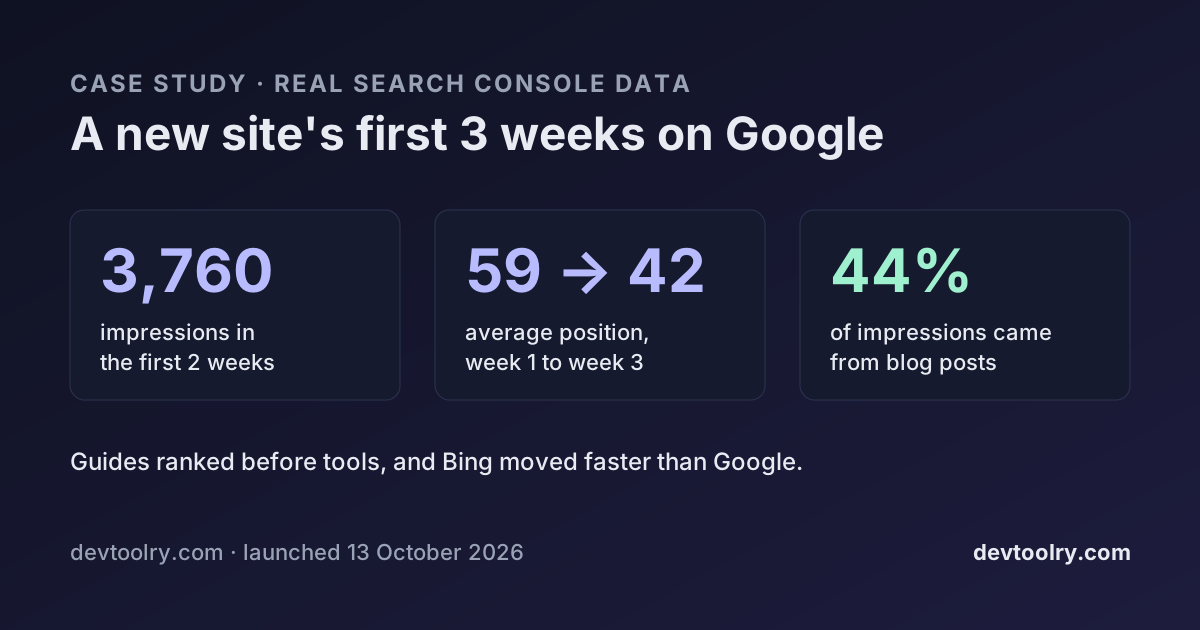
Over the first two weeks the site collected 69 clicks and 3,760 impressions.
Week 3: positions improve, clicks don't (yet)
| Week | Clicks | Impressions | Average position |
|---|---|---|---|
| 15–21 October | 30 | 1,870 | 58.9 |
| 23–29 October | 17 | 2,508 | 46.4 |
| 25–31 October | 15 | 2,721 | 42 |
Impressions kept rising and the average position improved from 59 to 42 in two weeks, yet clicks fell. The reason is in the queries: launch-week clicks were brand searches, and those faded. Of the 17 clicks in the week of 23 October only 2 were brand searches, so the 15 non-brand clicks are the real starting point.
Devices told a story too. In the week of 25 October desktop had 2,440 impressions at a 0.45% CTR, mobile only 270 impressions but a 1.48% CTR. Developer tools are searched at a desk, but phones click more readily on the results they do see.
Blog posts ranked first, tools later
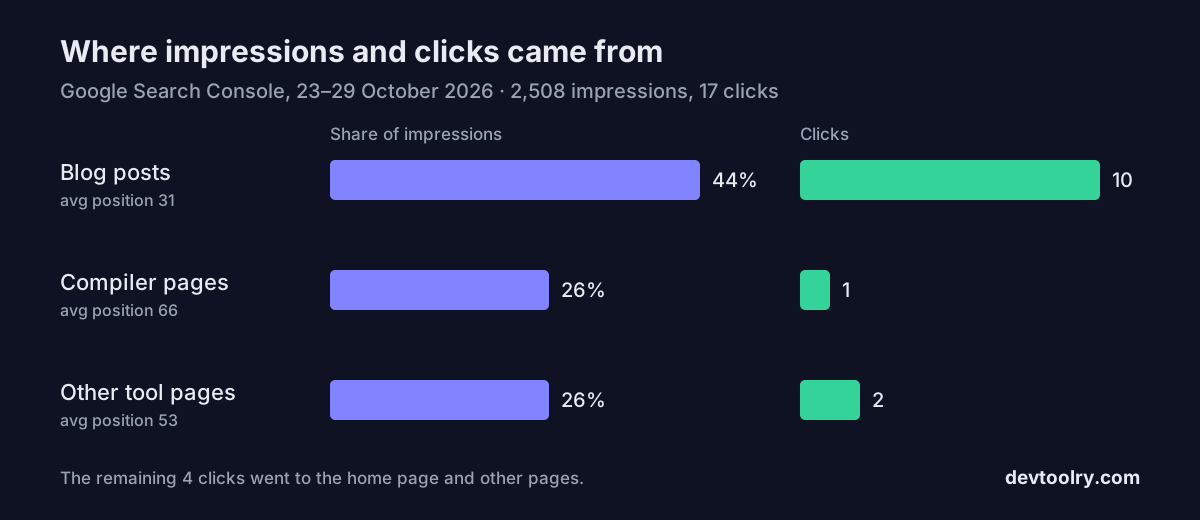
This was the biggest surprise. Tool pages target short, competitive searches ("online c compiler", "json formatter") where established sites have ranked for a decade. Our C compiler page collected 923 impressions in its first three weeks at an average position of 72, with one click.
Blog posts answer specific questions with less competition, so they climbed quickly. Our GCC vs Clang comparison reached an average position of 9.6 within three weeks and brought 7 clicks over that period; a post on strings in C sat at position 5.8. Those posts link to the tools, which is how a new tool site gets its first relevant visitors.
One odd result shows why you should read page-level data: our HTML viewer got 20 clicks in the same three weeks at an average position of 75. Averages hide a few queries where a page ranks well; the Search Console Analyzer exists because we kept digging for exactly those.
Bing moved faster than Google
Bing showed the site at average positions of 5 to 8 within days, while Google had it around 50. In the four days from 18 to 21 October Bing sent 81 clicks from 7,587 impressions; in the same four weekdays a week later it sent 18 clicks from 2,957. New sites often get an early lift in Bing that settles down, and part of ours came from one tool matching a very specific kind of query. Bing also powers Copilot and some other search features, so it is worth the ten minutes of setup.
What we changed because of the data
- Wrote more posts around questions that already had impressions, and linked each post to the tool it explains.
- Fixed titles once, then froze them. Some titles changed several times in the first two weeks; each change makes Google re-evaluate the page. We now wait about four weeks between title tests.
- Stopped worrying about "not indexed" totals and checked the reasons instead.
- Started on links. By the end of October Bing counted just 2 referring domains. Content gets you impressions; links from other sites are what move a new domain up for competitive terms, and they take the longest.
What to expect if you launch a site now
- Indexing in days, ranking in weeks or months. Being indexed only makes a page eligible.
- Brand clicks first, then a dip. Judge progress by non-brand clicks and impressions, not total clicks.
- Specific guides before broad pages. Answer real questions early; they carry the first visitors to your main pages.
- Bing is a quick early signal. Positions there can show which pages search engines consider relevant long before Google moves.
- Read the reasons, not the totals, in the indexing report.
We will publish the 30- and 90-day numbers as follow-ups. If you want to see your own data this way, the Search Console Analyzer reads your export in the browser, and our AI crawler study shows what the biggest sites allow in robots.txt.

Written by
Avinash Kori
Founder of Devtoolry
Avinash is a full-stack web developer from Surat, India, with eight years of experience in PHP, Laravel and Angular. He built Devtoolry so developers can solve everyday problems quickly with free tools that run entirely in the browser, and writes practical guides on the formats, encodings and techniques behind them.
Try it yourself
The free tools used in this article. They run in your browser, so nothing you paste is uploaded.
Search Console Analyzer
Drop your Google Search Console export to find page-2 keywords, low-CTR titles, question queries and cannibalised pages. Analysed in your browser, never uploaded.
Website SEO Checker
Check any page for on-page SEO problems: title, meta description, headings, canonical, robots.txt, noindex, structured data, alt text, HTTPS and speed, with a score.
Sitemap Validator
Validate an XML sitemap or sitemap index: format, URL limits, duplicates, lastmod dates, robots.txt blocks, and the status of every listed URL (404s, redirects, noindex).