GEO Checklist: How to Get Your Pages Into AI Answers (2026)
What Google, OpenAI and Anthropic actually require before AI answers can cite your page, what Google says to ignore, and an 8-point GEO checklist to test it.
 By Avinash KoriPublished 6 min read
On this page
Generative engine optimization (GEO) is the work of making a page usable as a source by AI search: Google's AI Overviews and AI Mode, ChatGPT search, Claude, Perplexity and Microsoft Copilot. The field is full of advice, and much of it is guesswork. This checklist sticks to what the operators of these systems have documented, and marks clearly where it moves from requirements to good practice.
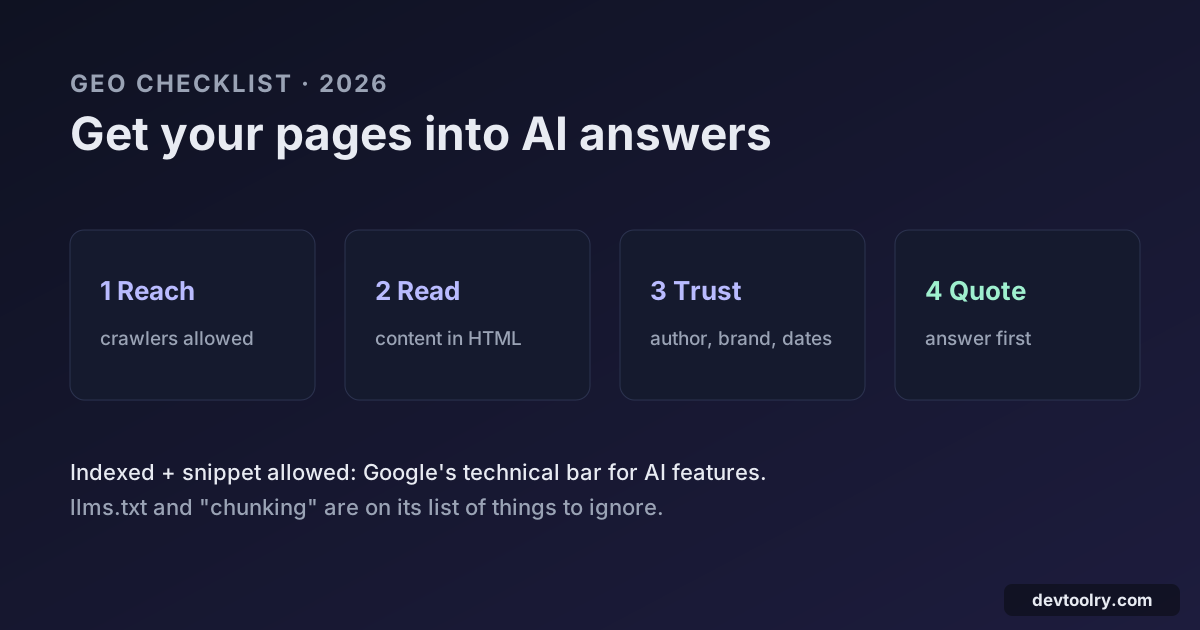
The short version: an AI engine can only cite a page it is allowed to fetch, can read, and can trust. Most of that is ordinary SEO done well. Google says so directly: in its guide to optimizing for generative AI, it describes AI search optimization as still being SEO, and lists several popular "GEO" tactics as unnecessary.
What Google actually requires
Google's documentation on AI features is unusually specific. To be eligible as a supporting link in AI Overviews or AI Mode, a page "must be indexed and eligible to be shown in Google Search with a snippet", and Google adds that "there are no additional technical requirements". Its AI features page and its guide to optimizing for generative AI also say the site must be included in Search generative AI features in Search Console (sites are included unless the owner opts out).
That gives three hard requirements, and each one is easy to break by accident:
- The page is indexable. No
noindexin the robots meta tag or theX-Robots-Tagheader, and Googlebot is not blocked in robots.txt. - Snippets are allowed.
nosnippetormax-snippet:0makes a page ineligible. If you only want to hide part of a page, use thedata-nosnippetattribute on that part instead. - The page returns 200. Redirect chains, soft 404s and server errors keep pages out of the index.
Microsoft Copilot builds on Bing's index, so the same logic applies to Bingbot. Our HTML meta tags guide covers the robots directives in detail.
What Google says you can ignore
The same guide has a list of things you do not need to do for Google's AI features. Three of them are sold hard by GEO tools and agencies:
- llms.txt and other AI files. Google says you do not need to create machine-readable files, AI text files or special markup to appear in Google Search, and that Google Search ignores them.
- "Chunking" content. There is no requirement to break content into small pieces for AI. Google's systems understand normal pages.
- Rewriting content for AI. You do not need special phrasings or every long-tail variation of a keyword; the systems understand synonyms.
Instead, Google says that creating content people find "unique, compelling, and useful" will likely influence a site's presence in generative AI search more than any other suggestion in the guide. That is why our GEO Score Checker reports llms.txt as a note and never adds it to the score.
Let the right crawlers in
Outside Google, each AI company runs several crawlers, and they do different jobs. Blocking a training crawler keeps your pages out of future model training. Blocking a search crawler removes the site from that company's AI answers. Many sites mix these up.
| Crawler (robots.txt token) | Operator | What blocking it does |
|---|---|---|
| Googlebot | Removes the page from Google Search, AI Overviews and AI Mode | |
| Google-Extended | Stops use for Gemini training and grounding; no effect on Google Search | |
| Bingbot | Microsoft | Removes the page from Bing and Copilot answers |
| OAI-SearchBot | OpenAI | Removes the page from ChatGPT search results |
| GPTBot | OpenAI | Keeps the page out of OpenAI model training |
| Claude-SearchBot | Anthropic | Removes the page from Claude search results |
| ClaudeBot | Anthropic | Keeps the page out of Anthropic model training |
| PerplexityBot | Perplexity | Removes the page from the Perplexity search index |
If you want to stay out of training but remain citable, block only the training tokens:
User-agent: GPTBot
User-agent: ClaudeBot
User-agent: Google-Extended
User-agent: CCBot
Disallow: /

User-agent: *
Allow: /

Sitemap: https://example.com/sitemap.xml
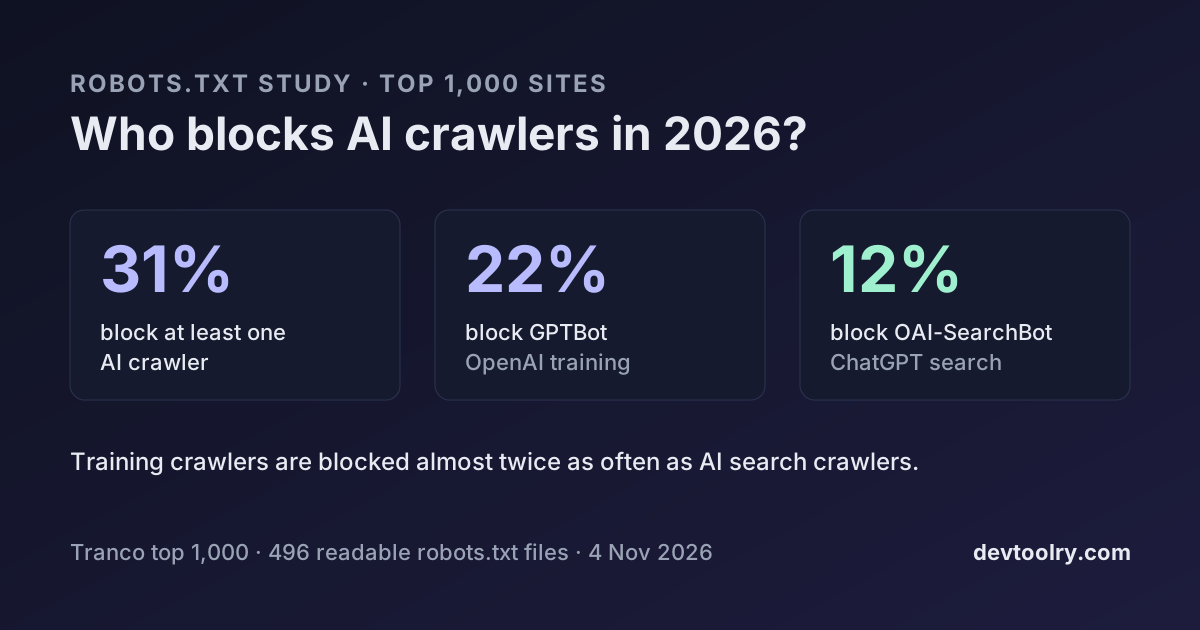
Run through our robots.txt matcher, this file blocks 4 of the 8 training crawlers we track and none of the 3 AI search crawlers. In our study of the top 1,000 sites, 21.6% blocked GPTBot but only 11.5% blocked OAI-SearchBot, so many large sites already make this split. Whether to block training at all is a business decision. The AI Crawler Checker shows the rule that applies to each crawler on your site.
Make the content readable without JavaScript
Googlebot renders JavaScript, but most other crawlers read only the HTML your server sends. A page that builds its content in the browser can look empty to them. Open your page with JavaScript disabled, or check the word count the GEO Score Checker reports under "Content without JavaScript". If the number is far below what a visitor sees, render the main content on the server with server-side rendering or static generation.
Write sections that can be quoted
AI answers quote passages, not pages, so a section should make sense when it is lifted out on its own. This is not "chunking" in the sense Google warns about: it is how good reference writing already works.
- Answer first. Start the page, and each section, with one to three sentences that answer the question in the heading.
- Name the subject. A section that opens with "This is why…" loses its meaning once quoted.
- Be specific. Numbers, dates, versions and named sources make a claim checkable.
- Use lists and tables for steps, options and comparisons.
The AI Citability Checker scores every section of a page on these points and lists the weakest first.
Show who is behind the page
Google's guidance on helpful content asks who created a page, how and why. For articles, show a byline that links to an author page, and put the author and dates in the Article schema. For the site, describe the organization with Organization JSON-LD (name, URL, logo) and list your official profiles in sameAs so engines connect the brand's mentions across the web. Link About and Contact pages from the home page. The Schema Markup Generator builds the Organization and Article markup.
Structured data is not a requirement for AI features, so treat it as a way to state facts unambiguously, not as a ranking trick.
The 8-point GEO checklist
These are the eight areas the GEO Score Checker tests, in order of weight:
- Search eligibility: 200 status, indexable, snippets allowed, Googlebot and Bingbot allowed, canonical set.
- AI crawler access: AI search crawlers and user-triggered fetchers allowed; training crawlers are your choice.
- Content without JavaScript: the main text and the H1 are in the server HTML.
- Content citability: a short answer at the top, quotable sections, numbers and sources.
- Brand and authorship: Organization schema with a logo and
sameAs, About and Contact pages, a named author on articles. - Structured data: valid JSON-LD that matches the visible content.
- Discovery: XML sitemap, title and meta description, Open Graph tags, a
langattribute. - Technical: HTTPS, a mobile viewport, and a server that answers quickly.
The score is capped at 35 when a page fails search eligibility, because nothing else matters until that is fixed.
Example results
We ran the checker on a few pages on 5 November 2026. Our own robots.txt study post scored 100: it is indexable, every AI search crawler is allowed, its full text is in the server HTML, and it has an author, dates and linked sources. Wikipedia's article on sourdough scored 94. Its content is excellent, but the HTML has no meta description, the site publishes no XML sitemap at the standard location, and its Organization schema lists no sameAs profiles.
Neither score predicts citations. No outside tool can see how an AI engine chooses its sources, and Google says the same of third-party SEO tools in general. A checklist can only make sure nothing on your side stops a good page from being used.
FAQ
Is GEO different from SEO? For Google, no: its AI features use the same index and ranking systems. Other engines add their own crawlers, which is why robots.txt rules for AI bots matter more than they used to.
Will an llms.txt file get me into ChatGPT or AI Overviews? Not into AI Overviews: Google says Google Search ignores the file. Some AI tools and coding assistants read it, so it is a harmless extra, but not a way into AI answers.
How long until changes show up? Fixes to robots.txt and indexing take effect when crawlers come back, usually days to weeks. Content changes need a recrawl too: request indexing in Search Console for Google, and ping IndexNow for Bing (and so Copilot).

Written by
Avinash Kori
Founder of Devtoolry
Avinash is a full-stack web developer from Surat, India, with eight years of experience in PHP, Laravel and Angular. He built Devtoolry so developers can solve everyday problems quickly with free tools that run entirely in the browser, and writes practical guides on the formats, encodings and techniques behind them.
Connect on LinkedInTry it yourself
The free tools used in this article. They run in your browser, so nothing you paste is uploaded.
GEO Score Checker
Check if AI search can reach, read and quote a page: indexing, AI crawler access, content without JavaScript, citable sections, brand schema and authorship, scored by area.
AI Crawler Checker
Check which AI crawlers a site allows: GPTBot, ClaudeBot, PerplexityBot, Google-Extended and 12 more, split into AI training, AI search and search engines.
Schema Markup Generator
Generate JSON-LD schema markup for FAQ, Article, Product, Organization, Local Business, Breadcrumb and Event pages, with checks for the fields Google requires.