Domain Age of the Top 1,000 Sites: Does It Matter for SEO? (2026 Study)
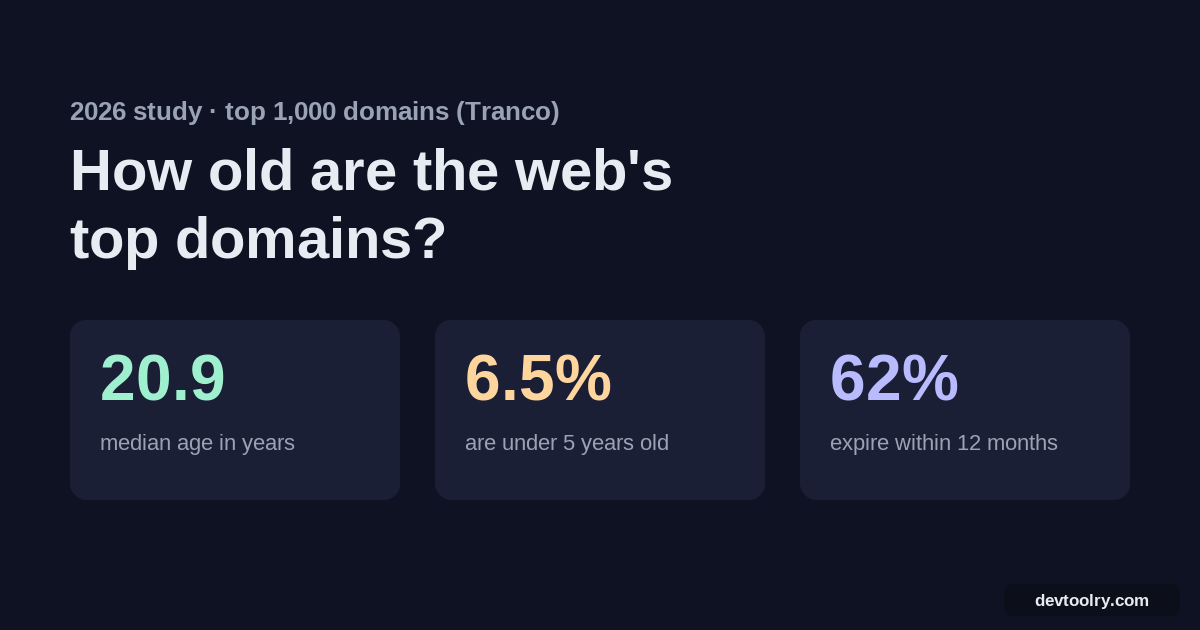
We looked up the registration dates of the top 1,000 domains: the median is 20.9 years old, 6.5% are under 5, and 62% expire within the next 12 months.
 By Avinash KoriPublished 5 min read
On this page
"Buy an aged domain, it will rank faster" is one of the oldest pieces of SEO advice, and one of the most sold. We wanted to see what the age of the web's most visited domains actually looks like, and what it does and does not tell you. On 13 November 2026 we looked up the registration record of the top 1,000 domains with the same code as our Domain Age Checker.
The short version: the median top-1,000 domain was registered in December 2005 and is 20.9 years old, and only 6.5% are younger than five years. But age barely moves with rank once you leave the top 100, the young domains that made it include ChatGPT, Bluesky and Perplexity, and 62% of these domains expire within the next 12 months, so long registrations are not what big sites do.
How we ran the study
We took the top 1,000 domains of the Tranco list downloaded on 12 November 2026, the research ranking we also used for our security headers study and robots.txt mistakes study. Tranco ranks registered domains by traffic signals averaged over 30 days, so the list includes infrastructure names (CDNs, DNS, ad and API hosts) next to websites. We kept them: they are domains like any other, and some of the youngest entries are exactly those.
For each domain we asked the registry over RDAP, the JSON protocol that replaced WHOIS for generic endings, and fell back to classic WHOIS on port 43 where a country registry has no RDAP server. 846 answers came from RDAP and 150 from WHOIS. 996 of the 1,000 domains returned a record, and 960 had a creation date. The 36 without one are mostly German .de domains (DENIC does not publish creation dates), US universities (.edu) and a few country endings that hide the date. Every percentage below is of those 960 unless it says otherwise.
A registry's creation date is when the current registration began. A domain that lapsed and was registered again starts over, and a domain bought from another owner keeps its date. That is the same date search engines and every domain age tool can see.
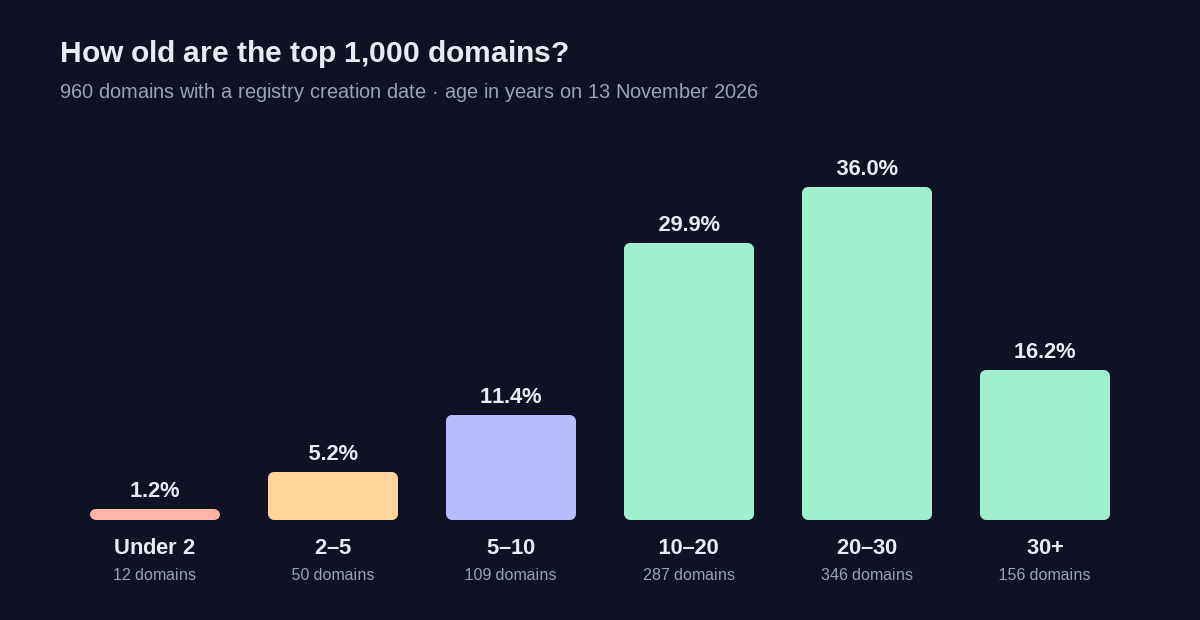
Most top domains are 20 years old or more
| Age | Domains | Share |
|---|---|---|
| Under 2 years | 12 | 1.2% |
| 2–5 years | 50 | 5.2% |
| 5–10 years | 109 | 11.4% |
| 10–20 years | 287 | 29.9% |
| 20–30 years | 346 | 36.0% |
| 30 years or more | 156 | 16.2% |
82% of the top domains are at least ten years old, and a third (31.7%) were registered before 2000. The oldest are the names of the computer companies that were on the internet before the web: hp.com and ibm.com (both March 1986), intel.com, adobe.com and unisys.com (1986), apple.com and cisco.com (1987), and dell.com and oracle.com (1988).
It is tempting to read this as "old domains rank". It is the other way round. These are companies that have been building products, earning links and collecting visitors for decades. The domain is old because the business is old, and a business that failed in 2004 is not in this list at all: we only see the survivors.
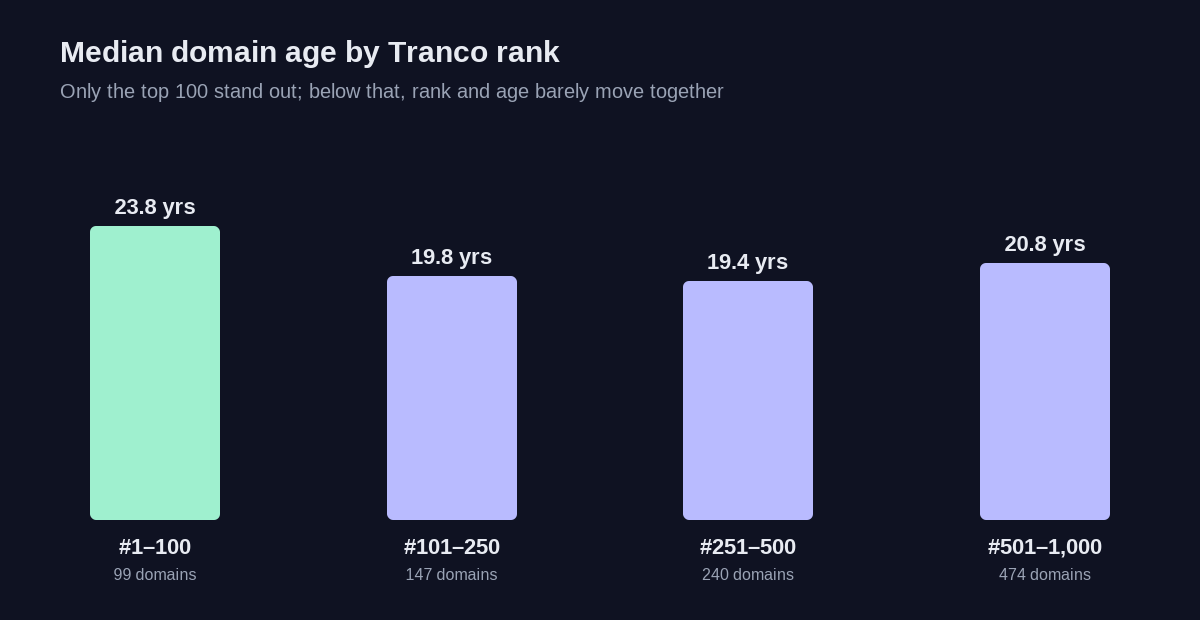
Rank and age barely move together
| Tranco rank | Domains with a date | Median age | Under 5 years |
|---|---|---|---|
| 1–100 | 99 | 23.8 years | 2 |
| 101–250 | 147 | 19.8 years | 12 |
| 251–500 | 240 | 19.4 years | 24 |
| 501–1,000 | 474 | 20.8 years | 24 |
The top 100 are older (a median of 23.8 years), which is the Googles, Microsofts and Amazons of the world. Below that, the median sits around 20 years whatever the rank: the domains ranked 501–1,000 are slightly older than those ranked 101–500. If age were a strong advantage in itself, we would expect a steady slope here. There is none.
The young ones are products people wanted
62 of the top domains are less than five years old. Most are infrastructure: new CDN and DNS names from Vercel, Microsoft, TikTok and Fastly, and short-lived hosts that appear in traffic data. A domain registered on 11 November 2026 sat at #40, which says more about how traffic rankings pick up new infrastructure than about websites.
The young domains that are websites tell the more useful story:
| Domain | Registry record since | Rank |
|---|---|---|
| chatgpt.com | November 2022 | #115 |
| bsky.app | September 2022 | #380 |
| cursor.sh | April 2023 | #778 |
| perplexity.ai | July 2022 | #833 |
None of them waited for their domain to age. They had something millions of people wanted to use, and the links, mentions and searches followed within two or three years. That matches what Google says. Asked whether domain age is a ranking factor, Google's John Mueller answered "No, domain age helps nothing" (reported by Search Engine Journal and earlier Search Engine Roundtable). What an older site does have is time: years of content, links and a history that search engines can trust. Those things count, and a new domain can earn them.
Long registrations are not a big-site habit
Another old tip says that registering a domain for ten years signals trust. Of the 936 domains whose record has an expiry date, 582 (62.2%) expire within the next 12 months, 254 within one to five years, and only 100 (10.7%) are paid five or more years ahead. Most of the web's biggest names simply renew every year, usually automatically, through corporate registrars: MarkMonitor alone manages 274 of the 996 domains we found (27.5%), and 50 of the top 100.
Renew automatically so you never lose the name, and lock it at your registrar. How far ahead you pay is a billing choice, not an SEO one.
What this means for your site
- Do not buy an aged domain for rankings. Its age is not a ranking factor, and an expired domain's old links and reputation may not carry over. A domain with a spam history can even hold you back; check its past in the Spam Score Checker and the Internet Archive before you buy.
- Use age as a trust check, not a goal. Spam and phishing sites are usually days or weeks old, so a very young domain asking you for a link or a payment deserves a second look. The WHOIS Lookup shows the full record.
- Spend the time on what age stands for. Content people search for, links from relevant sites and a technically sound site. Our SEO guide walks through those steps in order, and our first weeks on Google shows what a brand-new domain can do in its first month.
Check any domain yourself
Paste up to 100 domains into the Domain Age Checker to get their registration dates, ages, expiry dates and registrars straight from the registries, sorted oldest or newest first, with a CSV. The Domain Overview puts age next to authority, spam signals, hosting and SSL for a single domain.
Domain ages change by the day and rankings by the week, so treat these figures as a snapshot of 13 November 2026.

Written by
Avinash Kori
Founder of Devtoolry
Avinash is a full-stack web developer from Surat, India, with eight years of experience in PHP, Laravel and Angular. He built Devtoolry so developers can solve everyday problems quickly with free tools that run entirely in the browser, and writes practical guides on the formats, encodings and techniques behind them.
Connect on LinkedInTry it yourself
The free tools used in this article. They run in your browser, so nothing you paste is uploaded.
Domain Age Checker
Find how old a domain is: registration date, age in years, expiry and registrar for up to 100 domains at once, straight from RDAP and WHOIS, with CSV export.
WHOIS Lookup
Look up who registered a domain: registrar, creation and expiry dates, domain age, status codes, name servers and DNSSEC, from RDAP or WHOIS for any domain ending.
Domain Authority Checker
Check the authority of up to 100 domains at once: a 0–100 score from the open link graph, linking domains, Tranco rank and monthly history since 2018.
Domain Overview
Analyse any domain in one report: authority score and history, domain age, spam signals, hosting, SSL, security headers and technology, with links to every detail.